Artificial Intelligence is changing the way students learn and how teachers support them. In traditional education, all students often follow the same lessons, complete similar assignments, and move through topics at nearly the same pace. However, every student has different abilities, interests, learning speeds, and educational needs. This is where the role of AI in personalized learning becomes important. Artificial Intelligence can help create learning experiences that are more suitable for individual students.
AI in personalized learning uses intelligent systems to understand student performance, identify learning needs, and provide suitable educational content. It can help students practice difficult topics, receive quick feedback, and learn at a comfortable pace. At the same time, teachers can use AI based information to understand where students need additional support. As technology continues to develop, personalized learning with AI is becoming an important part of modern education.
What Is Personalized Learning?
Personalized learning is an educational approach that focuses on the individual needs of each student. Instead of expecting every learner to understand a topic in exactly the same way, personalized learning allows students to receive different types of support based on their performance and learning preferences.
For example, one student may understand mathematics quickly while another student may need additional examples and practice. In a traditional classroom, it can be difficult for one teacher to provide individual attention to every student. AI can help solve this problem by analyzing learning activities and recommending suitable resources.
Personalized learning does not mean that technology replaces teachers. Instead, it gives teachers additional tools to understand students and provide better educational support.
How AI Supports Personalized Learning
One of the biggest advantages of AI in personalized learning is its ability to analyze large amounts of student data. AI systems can examine quiz results, assignment performance, learning time, mistakes, and progress to identify patterns.
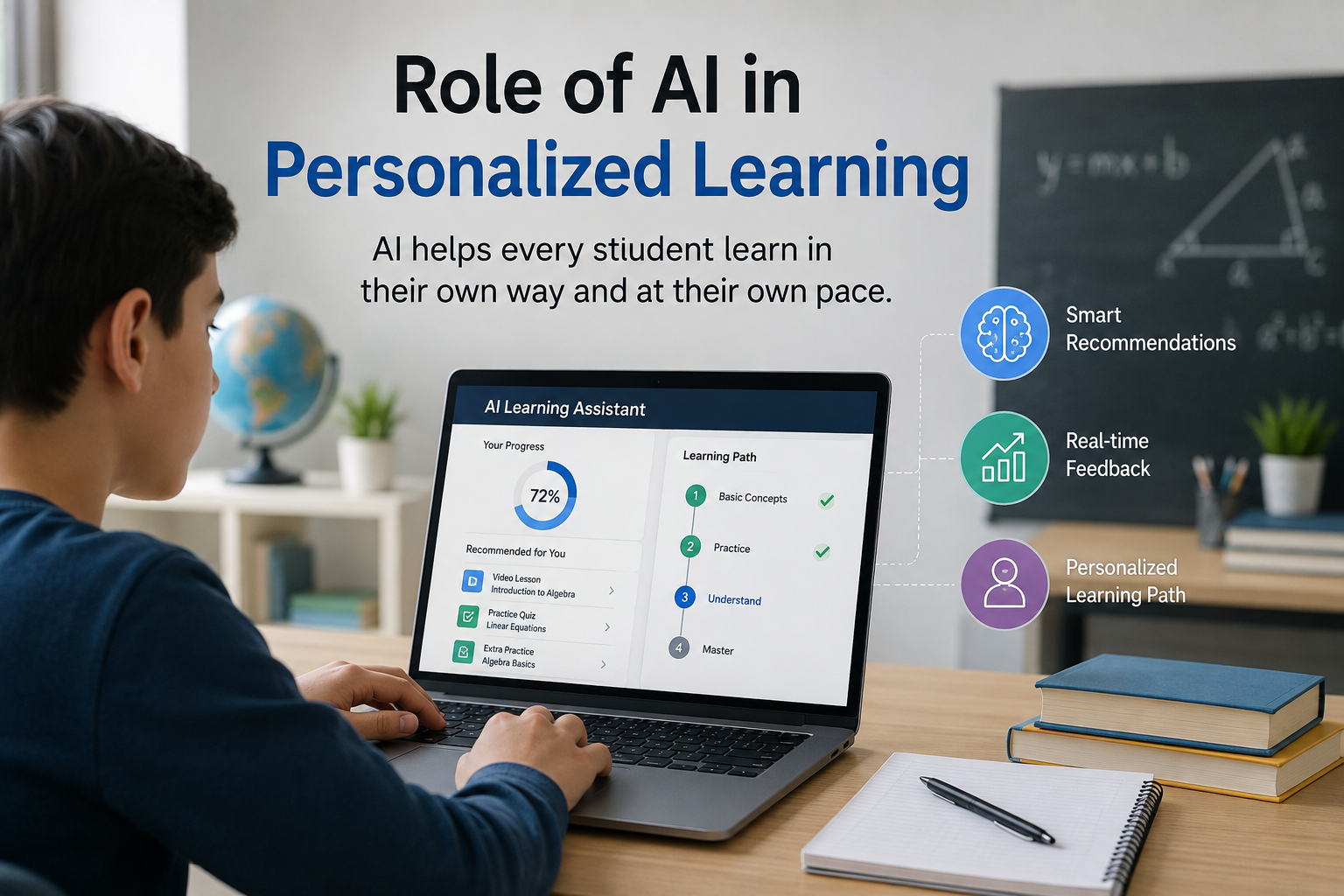
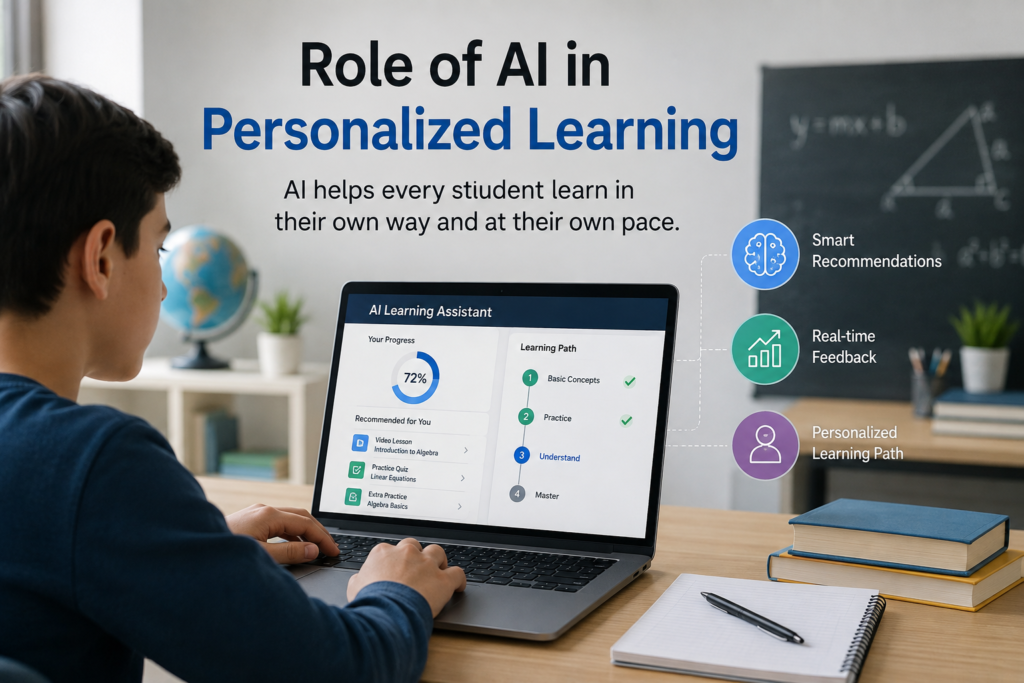
When an AI learning platform notices that a student is struggling with a particular topic, it can recommend additional lessons or practice exercises. If a student performs well, the system may provide more advanced material. This creates a learning experience that can change according to student progress.
AI can also provide instant feedback. Students do not always have to wait for a teacher to check their work. An intelligent learning system can identify common mistakes and explain possible solutions. Quick feedback can help students understand their errors while the information is still fresh in their minds.
AI Helps Students Learn at Their Own Pace
Students do not learn at the same speed. Some learners understand a concept after one explanation, while others need several examples before they feel confident. AI powered educational platforms can support different learning speeds.
A student who needs more time can repeat lessons and practice exercises without feeling pressured by the pace of the entire class. Another student who understands a topic quickly can move toward more challenging material.
This flexibility can make learning more comfortable and effective. Students can focus on improving their weaknesses while continuing to develop their strengths.
AI Can Identify Learning Gaps
Learning gaps can become a serious problem when students move to more advanced topics without fully understanding the basics. AI can help identify these gaps at an early stage.
For example, if a student repeatedly makes mistakes in fractions, an AI system may recognize that the student needs additional practice with basic mathematical concepts. The system can then recommend relevant lessons before introducing more difficult topics.
This approach allows students to build a stronger foundation. Instead of simply showing a low test score, AI can help explain which areas require attention.
Personalized Recommendations Through AI
Another important role of AI in personalized learning is providing educational recommendations. AI systems can suggest videos, articles, quizzes, exercises, simulations, and other learning materials based on student performance.
For example, a student learning English may receive vocabulary exercises based on words they frequently get wrong. A science student may receive additional visual explanations if they have difficulty understanding a particular concept.
These recommendations can reduce the amount of time students spend searching for useful resources. They can focus more directly on the content that matches their current learning needs.
AI Supports Teachers
The benefits of AI in personalized learning are not limited to students. Teachers can also use AI tools to make better educational decisions.
AI can provide teachers with information about student progress and common areas of difficulty. If several students are struggling with the same lesson, the teacher can review that topic again. If only a few students need help, the teacher can provide targeted support while allowing other students to continue.
AI can also reduce some routine educational tasks. Certain systems can help with basic assessments, feedback, lesson recommendations, and progress tracking. This can give teachers more time to focus on communication, creativity, classroom activities, and personal guidance.
AI Tutors and Virtual Learning Assistants
AI tutors are becoming another useful part of personalized education. An AI tutor can answer questions, explain concepts, provide examples, and offer practice activities.
Students can interact with an AI learning assistant when they need help outside regular classroom hours. This can be especially useful for students who prefer asking questions privately or who need repeated explanations.
However, AI tutors should be used as support tools rather than complete replacements for teachers. Human teachers understand emotions, classroom relationships, motivation, and personal circumstances in ways that technology cannot fully reproduce.
Benefits of AI in Personalized Learning
There are many benefits of using Artificial Intelligence for personalized education. One major benefit is improved student engagement. When learning materials match a student’s ability and interests, the student may become more interested in participating.
Another benefit is better learning efficiency. Students can spend more time practicing areas where they need improvement instead of repeatedly studying topics they already understand.
AI can also support independent learning. Students can use intelligent educational tools to explore topics, practice skills, and receive feedback without always depending on a teacher.
Personalized learning can also support different types of learners. Some students prefer visual explanations, while others learn better through reading, practice, or interactive activities. AI can help recommend different learning resources according to individual needs.
Challenges of AI in Personalized Learning
Although AI offers many advantages, it also has challenges. One important concern is student data privacy. AI systems often require information about learning performance, so schools and educational organizations must handle student data responsibly.
Another challenge is accuracy. AI systems can sometimes provide incorrect information or misunderstand a student’s needs. Teachers should review important recommendations and remain involved in the learning process.
There is also the issue of equal access to technology. Not every student has the same access to computers, reliable internet, or advanced educational platforms. Schools need to consider accessibility so that AI does not increase educational inequality.
Students may also become too dependent on AI if they use it for every task. Education should continue to develop critical thinking, creativity, communication, problem solving, and independent decision making.
The Future of AI in Personalized Learning
The future of AI in education is likely to include even more personalized learning experiences. AI systems may become better at understanding how individual students learn and which teaching methods work best for them.
Educational platforms may provide more detailed learning paths that change automatically as students improve. Teachers may receive clearer information about student progress and learning needs. AI may also support multilingual education, accessibility tools, interactive simulations, and personalized practice.
However, the most effective future will likely combine Artificial Intelligence with human teaching. Technology can analyze information quickly, but teachers provide encouragement, emotional support, creativity, and real classroom experience.
Conclusion
The role of AI in personalized learning is becoming increasingly important in modern education. Artificial Intelligence can analyze student performance, identify learning gaps, provide personalized recommendations, offer instant feedback, and help students learn at their own pace. It can also support teachers by providing useful information about student progress and reducing some routine tasks.
Despite its benefits, AI should be used carefully. Privacy, accuracy, equal access, and responsible use must remain important considerations. The goal should not be to replace teachers but to give them better tools for supporting students.
When AI and human teaching work together, personalized learning can become more flexible, engaging, and effective. As educational technology continues to improve, AI has the potential to help more students receive learning experiences that match their individual needs and abilities.