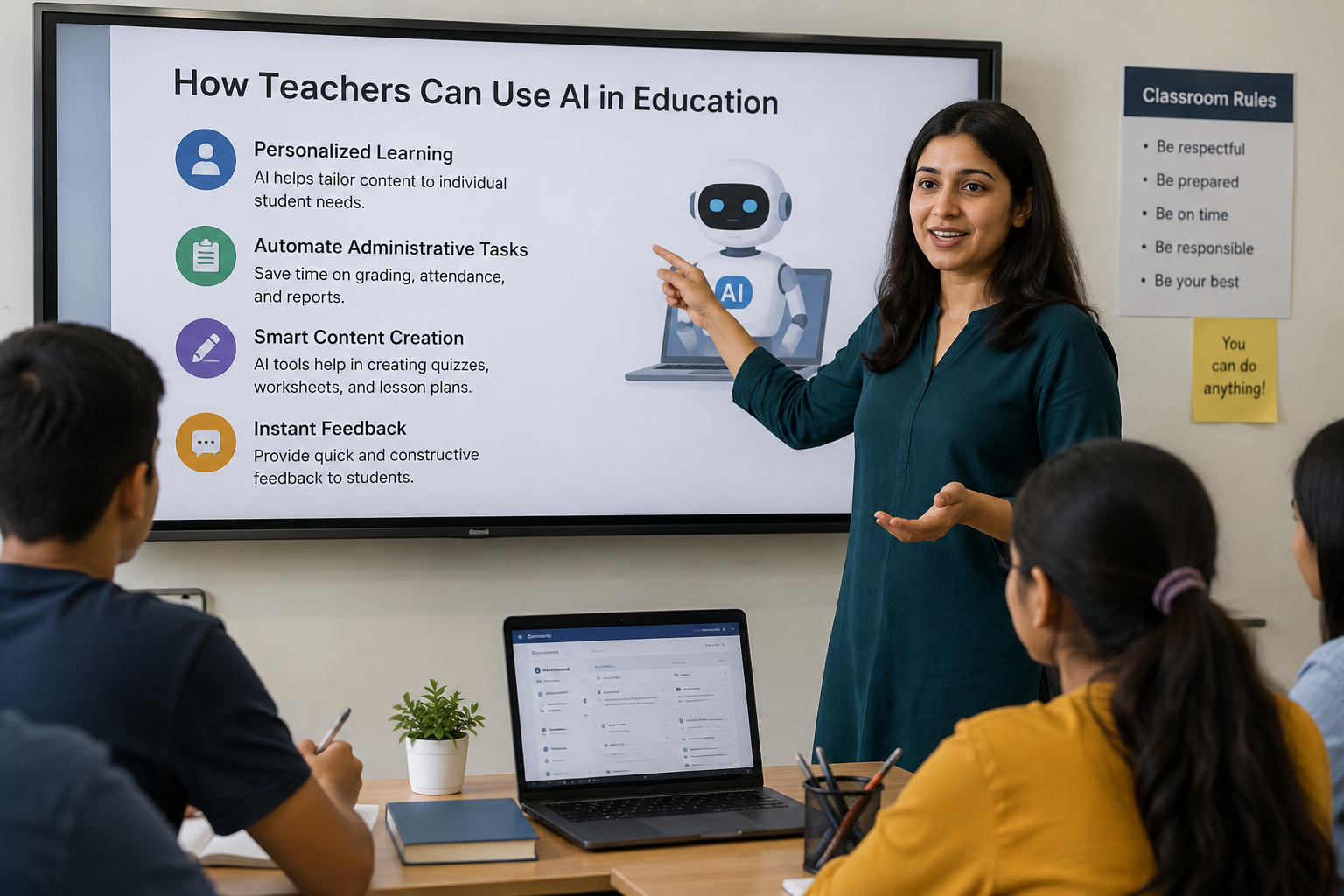
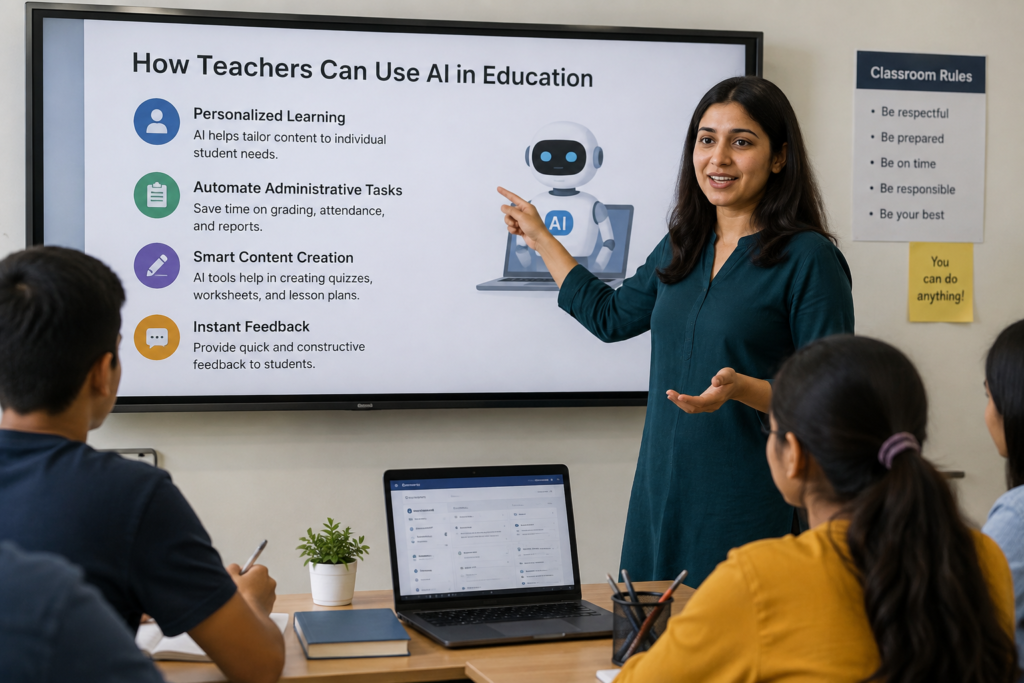
Artificial intelligence is becoming an important part of modern education. Teachers can use AI in education to save time, improve lesson planning, support students, and create more engaging learning experiences. AI tools are not designed to replace teachers. Instead, they can help teachers handle routine tasks and spend more time focusing on students.
The use of artificial intelligence in education is growing because schools and teachers need practical ways to provide better learning support. From creating lesson plans to preparing quizzes and explaining difficult topics, AI can assist teachers in many areas. When used responsibly, AI can become a useful teaching assistant that supports both educators and learners.
What Is AI in Education
AI in education refers to the use of artificial intelligence tools and technologies to support teaching and learning. These tools can understand information, generate content, analyze data, answer questions, and provide suggestions.
Teachers can use AI tools to prepare educational materials, develop classroom activities, create questions, and adapt lessons according to different student needs. Some AI systems can also analyze student performance and help teachers understand where learners may need additional support.
The most important point is that AI should support the teacher rather than replace human judgment. Teachers understand their students, classroom environment, and educational goals in ways that technology cannot fully understand.
AI for Lesson Planning
One of the best ways teachers can use AI in education is for lesson planning. Creating a detailed lesson plan can take a significant amount of time, especially when teachers need to prepare several lessons every week.
Teachers can provide an AI tool with a topic, grade level, learning objectives, and lesson duration. The tool can then suggest a basic lesson structure. It may provide ideas for introductions, classroom activities, discussion questions, examples, and assessments.
Teachers should review the AI generated content before using it in class. They can change the information, add personal examples, and make the lesson suitable for their students.
AI can therefore reduce preparation time while still allowing teachers to maintain control over the final lesson.
Creating Educational Materials With AI
Teachers regularly need worksheets, examples, exercises, reading passages, and classroom activities. AI can help create these materials quickly.
For example, a teacher teaching English can ask AI to create grammar exercises for a particular learning level. A science teacher can request questions about the solar system. A mathematics teacher can generate practice problems based on a specific topic.
Teachers can then edit the materials and make sure they match the curriculum. This can be especially helpful when teachers need multiple versions of an activity for students with different abilities.
Personalized Learning With AI
Every student learns differently. Some students understand a topic quickly, while others need additional explanations and practice. AI can help teachers provide more personalized learning support.
Teachers can use AI to create easier explanations for students who are struggling with a topic. They can also generate more challenging activities for advanced students.
For example, if students are learning fractions, an AI tool can help create basic practice questions for beginners and more advanced problems for students who are ready for additional challenges.
This approach can help teachers provide differentiated learning without creating every resource from the beginning.
AI for Student Assessment
Assessment is another area where AI can help teachers. Creating quizzes and practice tests manually can take time. AI tools can generate questions based on a lesson topic and learning objective.
Teachers can use AI to create multiple choice questions, short answer questions, discussion questions, and practice exercises. They should always check the questions for accuracy and relevance before giving them to students.
Some AI powered educational platforms can also help analyze student responses. This information may help teachers identify common mistakes and topics that require further explanation.
AI should not be the only method used to evaluate students. Teacher observation, classroom participation, projects, and personal feedback remain important parts of assessment.
Helping Students Understand Difficult Topics
Teachers can use AI to provide additional explanations when students have difficulty understanding a concept. AI can explain information in different ways and provide examples based on a student’s level.
For instance, a complicated scientific concept can be explained using simple language and everyday examples. A mathematical problem can be broken into smaller steps. A difficult vocabulary word can be explained with definitions and example sentences.
However, teachers should encourage students to think independently. AI should be used as a learning support tool rather than a way for students to avoid thinking or completing their own work.
AI for Classroom Activities
AI can help teachers make classroom activities more interesting. Teachers can ask AI for ideas for group discussions, educational games, role playing activities, debates, writing exercises, and problem solving tasks.
For example, a history teacher can create a classroom discussion around a historical event. A language teacher can develop conversation scenarios. A business teacher can create a simple business case for students to analyze.
These activities can increase student participation and make lessons more interactive.
Saving Time on Routine Tasks
Teachers have many responsibilities outside direct classroom teaching. They may need to prepare announcements, organize information, create instructions, and write general classroom communications.
AI can help with some of these routine tasks. Teachers can use it to organize ideas, improve the structure of educational documents, and create basic drafts.
Saving time on routine work allows teachers to focus more attention on teaching, student interaction, and classroom management.
AI for Feedback and Writing Support
Providing useful feedback is important for student development. Teachers can use AI to help identify common grammar problems, unclear sentences, or areas where a student’s writing may need improvement.
For example, AI can help a teacher prepare feedback categories for an essay assignment. It can suggest questions that encourage students to improve their arguments and organization.
Teachers should remain responsible for the final feedback. Students also need to understand why their work needs improvement instead of simply receiving an AI generated correction.
Supporting Teachers With Different Learning Needs
AI can help teachers create resources that are accessible to a wider range of students. Teachers may use AI to simplify complicated text, create alternative explanations, generate vocabulary support, or develop additional practice activities.
This can make classroom resources more flexible. Students who need extra explanation can receive additional support, while other students can continue working at their own level.
The teacher should always consider the individual needs of students and make sure AI generated resources are appropriate.
Responsible Use of AI in Education
Although AI provides many benefits, teachers need to use it responsibly. AI systems can sometimes produce incorrect information, biased content, or unsuitable recommendations. This means teachers should never accept AI generated information without checking it.
Privacy is also important. Teachers should avoid entering confidential student information into AI tools unless the platform is approved by their school or educational institution and appropriate privacy protections are in place.
Teachers should also explain to students how AI should be used. Students need to understand the difference between using AI for learning support and using AI to complete assignments dishonestly.
Teachers Still Matter
The growth of AI does not reduce the importance of teachers. In fact, teachers may become even more important as technology becomes more common in education.
AI can provide information, generate ideas, and automate certain tasks, but teachers provide encouragement, understanding, creativity, and human connection. Teachers know their students and can recognize emotional and social factors that technology may miss.
The best approach is to combine the strengths of AI with the experience and judgment of teachers.
Future of AI in Education
The future of AI in education is likely to bring more intelligent and personalized learning tools. Teachers may have access to systems that help analyze learning progress, create customized resources, and identify areas where students need support.
However, successful AI adoption will depend on proper training and responsible use. Teachers need to understand both the benefits and limitations of artificial intelligence.
Schools should provide clear guidelines and training so educators can use AI confidently and safely.
Conclusion
AI in education can provide valuable support for teachers when it is used carefully and responsibly. Teachers can use AI for lesson planning, educational materials, personalized learning, assessments, classroom activities, feedback, and routine tasks.
The main goal should not be to replace traditional teaching. Instead, AI should help teachers become more efficient and give students better learning opportunities.
Teachers who learn how to use AI effectively can combine technology with their own knowledge, creativity, and experience. This combination can create a more flexible, engaging, and personalized learning environment.
Artificial intelligence is changing education, but the teacher remains at the center of the learning process. When teachers use AI as a supportive tool rather than a replacement for human teaching, it can become a powerful part of modern education.